

Climate to community, farms to forestry – excellence celebrated at Scotland’s Finest Woods Awards 2025
A school which has taken lessons on climate change out of the classroom and into the real world, and a project using trees to stop a notorious flooding problem are among the champions honoured at this year’s Scotland’s Finest Woods Awards.
When you add in a project to plant free nut and fruit trees in urban gardens where greenspaces are limited and the transformation of a Highland croft that has been in the same family for centuries, the excellence and breadth of projects from the winners makes it one of the best years ever.
Jean Nairn, Executive Director of Scotland’s Finest Woods, said: “This has been an exceptional year for Scotland’s Finest Woods Awards.
“From young foresters to crofters, commercial plantations to trees making our cities breathe, the work we have seen has been inspiring.
“Scotland’s woodlands and forests are growing stronger and better every year – it is great to be able to champion them and encourage more achievements in the future.”
Scotland’s Finest Woods Awards 2025 saw 10 trophies awarded in seven categories – Quality Timber, Farm Woodland, New Native Woods, Community Woodlands, Climate Change Champion, Schools and Early Years, and the new Urban Forestry Award.
Rural Affairs Secretary Mairi Gougeon presented the awards at the Scottish Parliament event, she said: “What a fantastic celebration these awards are – they showcase the very best of Scotland’s woodlands. The enthusiasm and passion of all those involved in managing their woodlands shines through each year.
“The awards cover a vast range of woodland types from quality timber, native, community, farm and urban woodlands, to woodlands for schools and early years children. The breadth of the awards itself demonstrates how forestry today is woven into so many aspects of Scottish life.
“Congratulations to all the winners and especially to the schools and young people – you are our foresters of the future and your work is very inspiring.”
Selkirk High School took the Climate Change Champion Award for their passion and drive to educate students on how climate change and global warming is affecting us on a localised level and providing simple measures to address those effects.
They built on their success of last year, when they won the Schools Award – this year they also enjoyed being selected as runner up in that category.
Two members of school staff, Maddy Pope and Anna Johnson, said they saw an opportunity to use winning the Schools Award last year as a platform to highlight how the “simple act of planting a tree can not only benefit local wildlife and improve biodiversity but also have a direct positive effect on climate change”.
They already offered the Junior Forester Award to S2s and Horticulture and Rural Skills to S3 and above, and now they have developed a range of new courses, right up to the senior phase of the school.
Seed harvesting and propagating has seen the school growing bananas, dates, lemons, pomegranates, avocado and many native Scottish trees as well as vegetables and fruit, available to the local community. There are also weekly Forest School sessions.
The judges said the entry was “a compelling account of coherent actions taken to raise awareness and engage in activities to tackle climate change – with trees as a focus”. They added: “This included comprehensive and concerted efforts to develop a new curriculum, engage pupils of a range of abilities in relevant activities, and signpost routes to careers in forestry and horticulture as enduring responses to the climate crisis.”
Forestry and Land Scotland were winners, with Transport Scotland, of the Woodland Trust Scotland Trophy for New Native Woods for Rest and Be Thankful, Argyll.
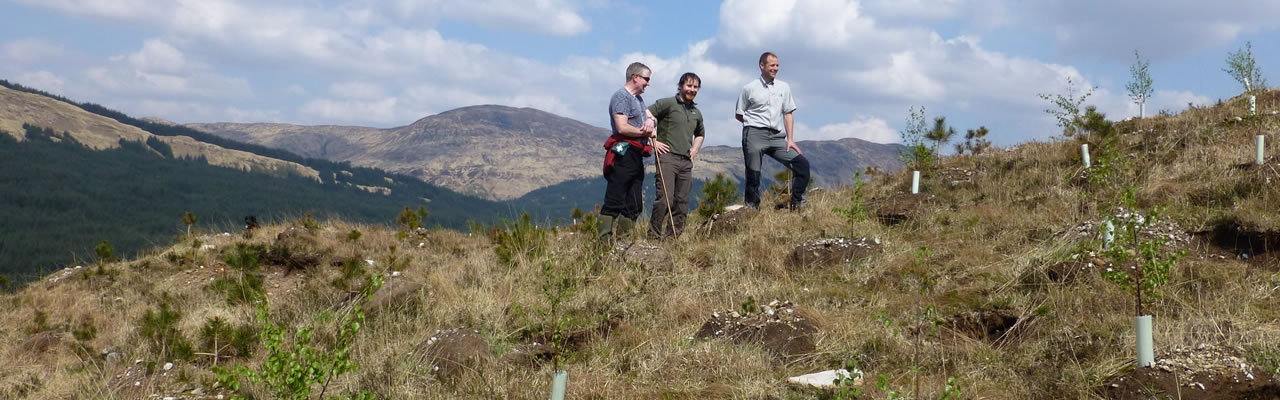
The Rest and Be Thankful Woodland Creation site is located on the steep south western flanks of Ben Luibhean above the A83 trunk road, at the head of Glen Croe. These slopes are notoriously unstable and, over the past few years, a number of engineering works have been carried out to help stabilise them and protect the road infrastructure.
Native woodland creation complements the “hard” engineering and brings other benefits such as improved water quality and added landscape and conservation value.
Forestry and Land Scotland, with operations forester James Hand, is working with Transport Scotland, planting a mixed native woodland with a range of species selected to maximise slope stability. Natural regeneration of native species is also encouraged and there is scope for further planting adjacent to the core project area.
This site is very challenging and has required the use of helicopters as well as experimenting with novel planting techniques to help establish the new woodland. Approximately 200 ha of new woodland creation has been undertaken to date. There is potential to undertake further woodland creation, moving tree planting into the montane areas of the site.
The judges had high praise: “In practice, this woodland creation carries a lot of weight. It demonstrates how the ancient practice of planting trees can assist modern day civil engineering in one of Scotland’s highest profile infrastructure projects, namely the stabilisation of fragile soils on the side of the A85.”
New for 2025 is the Urban Forestry Award and the Future Woodlands Scotland Trophy for Urban Forestry. It was won by TreeLink Stirling for their Free Nut and Fruit Trees project.
The aim is to “focus on the planting of urban trees, particularly in areas where trees are most needed”, which chimes with the ethos of the sponsors, Future Woodlands Scotland.
Selected neighbourhoods (Raploch and Bannockburn Community Council areas) which have very poor Tree Equity scores and very low levels of urban tree canopy were chosen. Residents were offered nut or fruit trees to plant in their gardens because trees that grow edible produce are popular and are likely to engender a long-term commitment to the welfare of the tree.
The trees – apple, plum, pear, walnut and hazelnut – were delivered to each recipient with the offer to plant them if requested.
The residents were delighted. One said: “I live in a block of four flats sharing a garden area. Having the tree makes me happy as it brightens up a space that other residents neglect.” Another added: “Our six children look after the tree and it’s so wonderful to have a tree in our garden.”
And the judges were impressed: “TreeLink is a great example of people with passion and energy using their knowledge to make a real difference to the place where they live. The project is getting trees in the ground, where they are most needed to deliver greatest benefit, but also seems to be bringing people together across a range of communities. We need a TreeLink in every town and city across Scotland!”
Farming and forestry form an important part of the awards and a great example was seen at Norman Laing’s croft at Edderton, near Tain, Highland.
His work with forestry agent Dietrich Pannwitz of Sylvestrus Ltd won the F & W Forestry Farm Woodland Award & the Lilburn Trophy for All Farm / Croft.
Rhanich Croft has been in Norman’s family since at least the 1800s and integrates sustainable woodland management with cattle and sheep rearing. Despite more than 37% of the croft now comprising of woodland, the condition of livestock has improved, achieving top prices when sold.
Key achievements include planting native pinewoods, productive conifers, and shelterbelts, enhancing biodiversity, reducing grazing costs, improving livestock shelter, and contributing to carbon sequestration.
The croft also generates income through carbon rights, timber production, and farm woodland payments, while supporting local employment.
The judges said the partnership working at Rhanich Croft has resulted in “true integration of farming and forestry”, adding that it was “inspirational”.
Rhanich Croft was also Highly Commended in the New Commercial Woods category, part of the Quality Timber Awards.
The winner of the Glennon Brothers New Commercial Woods Trophy was Rosebery Estates for Moorfoot, Midlothian.
This saw Rosebery Estate Partnership, Galbraith, and Michael Wilson of Scottish Woodlands Ltd work towards the establishment of a productive woodland as an alternative to agricultural activity on hill land.
While doing this they created mitigation for climate change through woodland expansion on a medium-large scale. And there was protection and enhancement of biodiversity values, primarily through the expansion of the forest habitat networks and the retention of areas of conservation value as open ground.
The enhancement of the landscape through the creation of a sensitively designed woodland reflected the local topography and the site’s cultural heritage value. Archaeological features were also protected and water quality was secured through adherence to the Forests and Water Guidelines.
The judges said: “The team (Rosebery Estate Partnership, Galbraith, and Michael Wilson of Scottish Woodlands Ltd) have achieved the establishment of an excellent new commercial woodland with very good access and potential for high productivity. They have done this while working together with a number of external stakeholders, with whom early engagement has built up a significant level of trust and understanding. All involved should be proud of what they have achieved.”
Forestry and Land Scotland also won the award for a Single Stand, Compartment or Small Wood and the Hunter Blair Trophy for Silvicultural Excellence, for Braeval Forest, Aberfoyle.
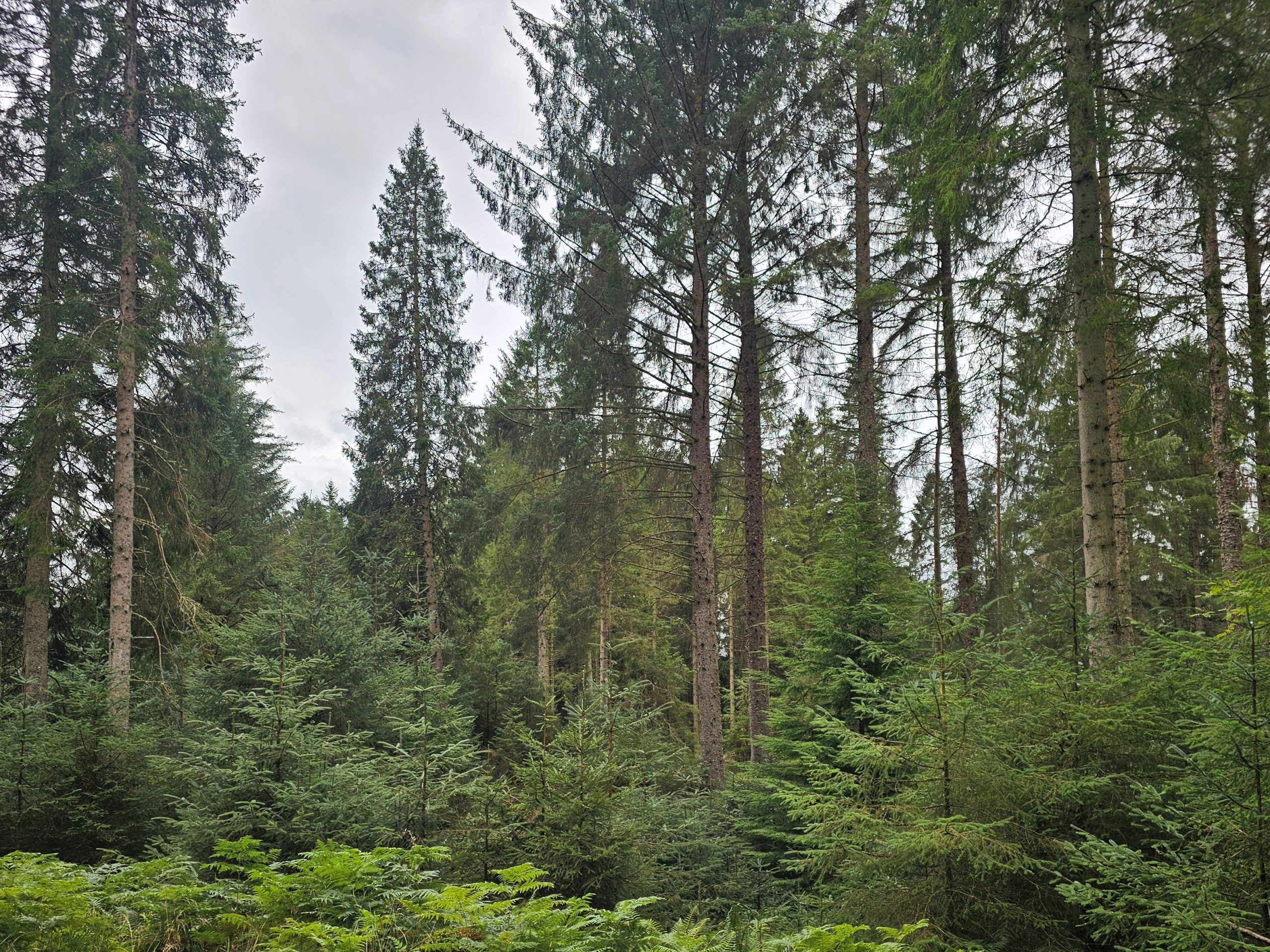
The judges said this was “an excellent example of a late conversion of a spruce stand to CCF (Continuous Cover Forestry) management on a potentially challenging site”.
It saw an improvement of timber quality and maximisation of economic returns through thinning.
It also maintained tree cover to protect the soil from erosion and provide shelter and food for wildlife, greater structural diversity through natural regeneration and provided public access and recreation activities.
The winner of the John Kennedy Trophy for Multi-purpose Woodlands for Whole Forest or Estate was Mr Dave Newman, c/o F & W Forestry, for Quinlochmuir Forest, Strathblane, Campsies.
Former summer grazing pasture for sheep and cattle has been transformed to provide woodland made up of conifers (45%), broadleaves (29%) and open ground (26%).
It provides a commercially viable plantation which can produce a sustainable volume of timber to the market with good road access.
At the same time, it provides an enjoyable wood for the public to enjoy, increases biodiversity and water quality, and maintains the integrity and setting of the hill fort and hills in the landscape.
The judges said: “Quinlochmuir is now a diverse well-established forest area with a substantial broadleaved component.”
The Community Woodlands Awards are an important part of the annual celebration.
The winner of the Large Community Woodland Group competition and of the Tim Stead Trophy for overall Community Woodland Award Winner was Gifford Community Woodland, owned by Gifford Community Land Company Ltd, for Fawn Wood and Speedy Wood in East Lothian.
Previous winners of the large community award in 2019, they have overseen seen the restoration of more native woodland, providing a place for recreation and activity for many community groups, including Forest Schools.
The Awards for the Schools and Early Years categories had been announced earlier in the year but both winners were at the ceremony to receive their trophies. The Alba Trees Early Years’ Trophy went to West Johnstone ELCC, in Johnstone, Renfrewshire, and Hardgate Primary School in Haugh of Urr, near Castle Douglas in Dumfries and Galloway, took the Crown Estate Scotland Schools’ Trophy.
Wilma Harper, the new Chair of Scotland’s Finest Woods, said: “This is the 40th anniversary year of Scotland’s Finest Woods and what a year it has been for celebrating all that is great about our woods and forests!
“Like the forests, the Awards have grown to encompass all elements of our finest woods. We celebrate our forests growing quality timber and protecting the environment, woods supporting farms and community enterprises, inspiring the next generation in schools and, for the first time this year, bringing trees to the heart of the cities.
“It has been a bumper year for applications, and our judges and director have been very busy. I’m grateful to the volunteers and to our sponsors and supporters whose contributions make this Awards Programme possible.
“All our entrants and winners play a vital role and every entry brings a story of collective endeavour and commitment. Well done all!”
Finlay Carson MSP, convener of the Scottish Parliament’s Rural Affairs and Islands Committee, and the Awards ceremony’s sponsor MSP, said: “It is a great honour to be hosting Scotland’s Finest Woods annual awards ceremony this year and I know from previous events that it promises to be a wonderful celebratory occasion to recognise marvellous achievements across this wide and growing sector.
“It will be nice to honour the winners on the night but also celebrate and pay tribute to the many others who have contributed so much to ensure Scotland’s Finest Woods finally get the recognition they so richly deserve.”

