forest landscape

A school which has taken lessons on climate change out of the classroom and into the real world, and a project using trees to stop a notorious flooding problem are among the champions honoured at this year’s Scotland’s Finest Woods Awards.

When you add in a project to plant free nut and fruit trees in urban gardens where greenspaces are limited and the transformation of a Highland croft that has been in the same family for centuries, the excellence and breadth of projects from the winners makes it one of the best years ever.

Jean Nairn, Executive Director of Scotland’s Finest Woods, said: “This has been an exceptional year for Scotland’s Finest Woods Awards.

“From young foresters to crofters, commercial plantations to trees making our cities breathe, the work we have seen has been inspiring.

“Scotland’s woodlands and forests are growing stronger and better every year – it is great to be able to champion them and encourage more achievements in the future.”

Scotland’s Finest Woods Awards 2025 saw 10 trophies awarded in seven categories – Quality Timber, Farm Woodland, New Native Woods, Community Woodlands, Climate Change Champion, Schools and Early Years, and the new Urban Forestry Award.

Rural Affairs Secretary Mairi Gougeon presented the awards at the Scottish Parliament event, she said: “What a fantastic celebration these awards are – they showcase the very best of Scotland’s woodlands. The enthusiasm and passion of all those involved in managing their woodlands shines through each year.

“The awards cover a vast range of woodland types from quality timber, native, community, farm and urban woodlands, to woodlands for schools and early years children. The breadth of the awards itself demonstrates how forestry today is woven into so many aspects of Scottish life.

“Congratulations to all the winners and especially to the schools and young people – you are our foresters of the future and your work is very inspiring.”

Selkirk High School took the Climate Change Champion Award for their passion and drive to educate students on how climate change and global warming is affecting us on a localised level and providing simple measures to address those effects.

They built on their success of last year, when they won the Schools Award – this year they also enjoyed being selected as runner up in that category.

Two members of school staff, Maddy Pope and Anna Johnson, said they saw an opportunity to use winning the Schools Award last year as a platform to highlight how the “simple act of planting a tree can not only benefit local wildlife and improve biodiversity but also have a direct positive effect on climate change”.

They already offered the Junior Forester Award to S2s and Horticulture and Rural Skills to S3 and above, and now they have developed a range of new courses, right up to the senior phase of the school.

Seed harvesting and propagating has seen the school growing bananas, dates, lemons, pomegranates, avocado and many native Scottish trees as well as vegetables and fruit, available to the local community.  There are also weekly Forest School sessions.

The judges said the entry was “a compelling account of coherent actions taken to raise awareness and engage in activities to tackle climate change – with trees as a focus”.  They added: “This included comprehensive and concerted efforts to develop a new curriculum, engage pupils of a range of abilities in relevant activities, and signpost routes to careers in forestry and horticulture as enduring responses to the climate crisis.”

Forestry and Land Scotland were winners, with Transport Scotland, of the Woodland Trust Scotland Trophy for New Native Woods for Rest and Be Thankful, Argyll.

The Rest and Be Thankful Woodland Creation site is located on the steep south western flanks of Ben Luibhean above the A83 trunk road, at the head of Glen Croe. These slopes are notoriously unstable and, over the past few years, a number of engineering works have been carried out to help stabilise them and protect the road infrastructure.

Native woodland creation complements the “hard” engineering and brings other benefits such as improved water quality and added landscape and conservation value.

Forestry and Land Scotland, with operations forester James Hand, is working with Transport Scotland, planting a mixed native woodland with a range of species selected to maximise slope stability. Natural regeneration of native species is also encouraged and there is scope for further planting adjacent to the core project area.

This site is very challenging and has required the use of helicopters as well as experimenting with novel planting techniques to help establish the new woodland. Approximately 200 ha of new woodland creation has been undertaken to date. There is potential to undertake further woodland creation, moving tree planting into the montane areas of the site.

The judges had high praise: “In practice, this woodland creation carries a lot of weight. It demonstrates how the ancient practice of planting trees can assist modern day civil engineering in one of Scotland’s highest profile infrastructure projects, namely the stabilisation of fragile soils on the side of the A85.”

New for 2025 is the Urban Forestry Award and the Future Woodlands Scotland Trophy for Urban Forestry. It was won by TreeLink Stirling for their Free Nut and Fruit Trees project.

The aim is to “focus on the planting of urban trees, particularly in areas where trees are most needed”, which chimes with the ethos of the sponsors, Future Woodlands Scotland.

Selected neighbourhoods (Raploch and Bannockburn Community Council areas) which have very poor Tree Equity scores and very low levels of urban tree canopy were chosen. Residents were offered nut or fruit trees to plant in their gardens because trees that grow edible produce are popular and are likely to engender a long-term commitment to the welfare of the tree.

The trees – apple, plum, pear, walnut and hazelnut – were delivered to each recipient with the offer to plant them if requested.

The residents were delighted. One said: “I live in a block of four flats sharing a garden area. Having the tree makes me happy as it brightens up a space that other residents neglect.” Another added: “Our six children look after the tree and it’s so wonderful to have a tree in our garden.”

And the judges were impressed: “TreeLink is a great example of people with passion and energy using their knowledge to make a real difference to the place where they live. The project is getting trees in the ground, where they are most needed to deliver greatest benefit, but also seems to be bringing people together across a range of communities. We need a TreeLink in every town and city across Scotland!”

Farming and forestry form an important part of the awards and a great example was seen at Norman Laing’s croft at Edderton, near Tain, Highland.

His work with forestry agent Dietrich Pannwitz of Sylvestrus Ltd won the F & W Forestry Farm Woodland Award & the Lilburn Trophy for All Farm / Croft.

Rhanich Croft has been in Norman’s family since at least the 1800s and integrates sustainable woodland management with cattle and sheep rearing. Despite more than 37% of the croft now comprising of woodland, the condition of livestock has improved, achieving top prices when sold.

Key achievements include planting native pinewoods, productive conifers, and shelterbelts, enhancing biodiversity, reducing grazing costs, improving livestock shelter, and contributing to carbon sequestration.

The croft also generates income through carbon rights, timber production, and farm woodland payments, while supporting local employment.

The judges said the partnership working at Rhanich Croft has resulted in “true integration of farming and forestry”, adding that it was “inspirational”.

Rhanich Croft was also Highly Commended in the New Commercial Woods category, part of the Quality Timber Awards.

The winner of the Glennon Brothers New Commercial Woods Trophy was Rosebery Estates for Moorfoot, Midlothian.

This saw Rosebery Estate Partnership, Galbraith, and Michael Wilson of Scottish Woodlands Ltd work towards the establishment of a productive woodland as an alternative to agricultural activity on hill land.

While doing this they created mitigation for climate change through woodland expansion on a medium-large scale. And there was protection and enhancement of biodiversity values, primarily through the expansion of the forest habitat networks and the retention of areas of conservation value as open ground.

The enhancement of the landscape through the creation of a sensitively designed woodland reflected the local topography and the site’s cultural heritage value. Archaeological features were also protected and water quality was secured through adherence to the Forests and Water Guidelines.

The judges said: “The team (Rosebery Estate Partnership, Galbraith, and Michael Wilson of Scottish Woodlands Ltd) have achieved the establishment of an excellent new commercial woodland with very good access and potential for high productivity. They have done this while working together with a number of external stakeholders, with whom early engagement has built up a significant level of trust and understanding. All involved should be proud of what they have achieved.”

Forestry and Land Scotland also won the award for a Single Stand, Compartment or Small Wood and the Hunter Blair Trophy for Silvicultural Excellence, for Braeval Forest, Aberfoyle.

The judges said this was “an excellent example of a late conversion of a spruce stand to CCF (Continuous Cover Forestry) management on a potentially challenging site”.

It saw an improvement of timber quality and maximisation of economic returns through thinning.

It also maintained tree cover to protect the soil from erosion and provide shelter and food for wildlife, greater structural diversity through natural regeneration and provided public access and recreation activities.

The winner of the John Kennedy Trophy for Multi-purpose Woodlands for Whole Forest or Estate was Mr Dave Newman, c/o F & W Forestry, for Quinlochmuir Forest, Strathblane, Campsies.

Former summer grazing pasture for sheep and cattle has been transformed to provide woodland made up of conifers (45%), broadleaves (29%) and open ground (26%).

It provides a commercially viable plantation which can produce a sustainable volume of timber to the market with good road access.

At the same time, it provides an enjoyable wood for the public to enjoy, increases biodiversity and water quality, and maintains the integrity and setting of the hill fort and hills in the landscape.

The judges said: “Quinlochmuir is now a diverse well-established forest area with a substantial broadleaved component.”

The Community Woodlands Awards are an important part of the annual celebration.

The winner of the Large Community Woodland Group competition and of the Tim Stead Trophy for overall Community Woodland Award Winner was Gifford Community Woodland, owned by Gifford Community Land Company Ltd, for Fawn Wood and Speedy Wood in East Lothian.

Previous winners of the large community award in 2019, they have overseen seen the restoration of more native woodland, providing a place for recreation and activity for many community groups, including Forest Schools.

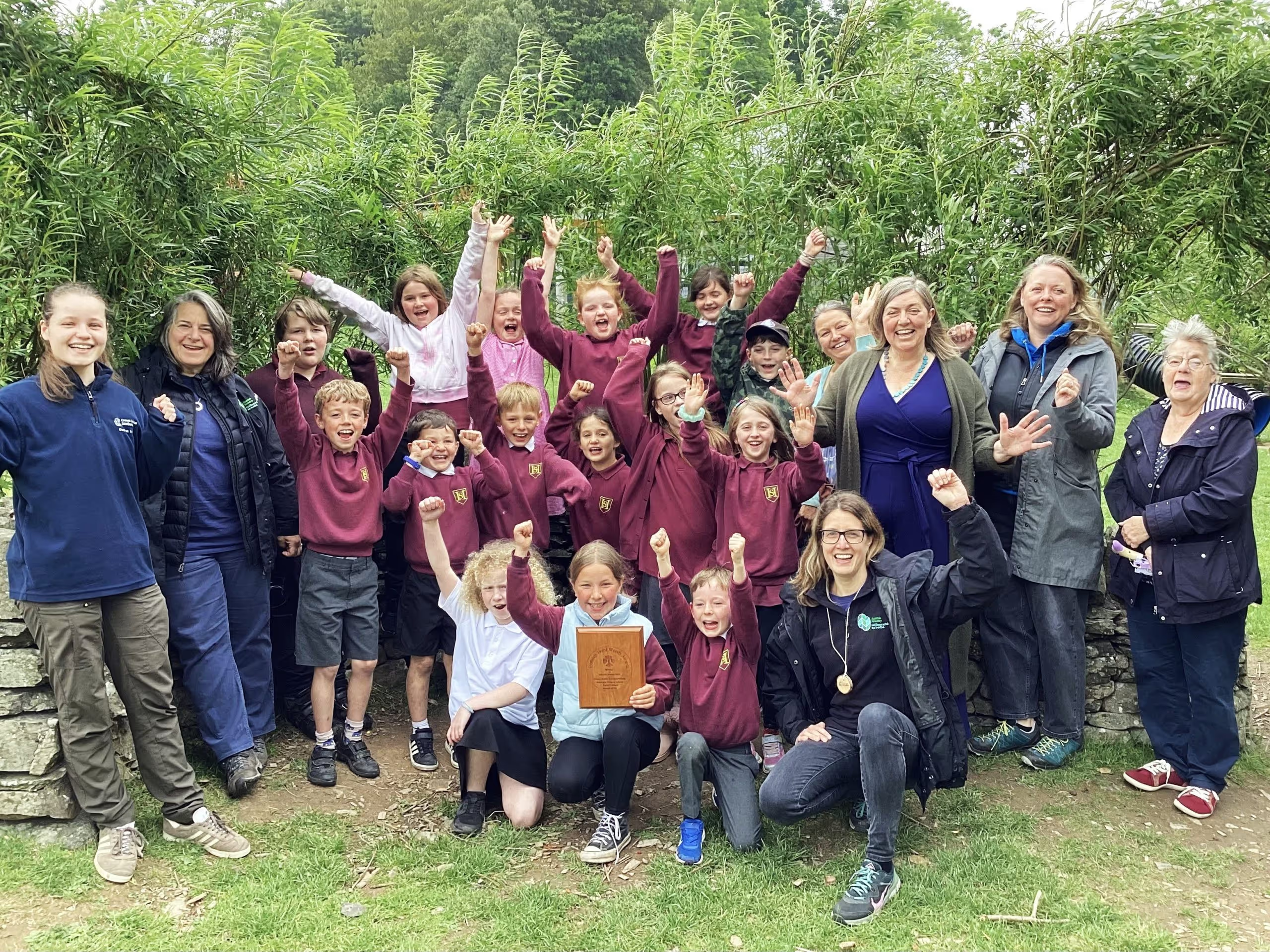
The Awards for the Schools and Early Years categories had been announced earlier in the year but both winners were at the ceremony to receive their trophies. The Alba Trees Early Years’ Trophy went to West Johnstone ELCC, in Johnstone, Renfrewshire, and Hardgate Primary School in Haugh of Urr, near Castle Douglas in Dumfries and Galloway, took the Crown Estate Scotland Schools’ Trophy.

Wilma Harper, the new Chair of Scotland’s Finest Woods, said: “This is the 40th anniversary year of Scotland’s Finest Woods and what a year it has been for celebrating all that is great about our woods and forests!

“Like the forests, the Awards have grown to encompass all elements of our finest woods. We celebrate our forests growing quality timber and protecting the environment, woods supporting farms and community enterprises, inspiring the next generation in schools and, for the first time this year, bringing trees to the heart of the cities.

“It has been a bumper year for applications, and our judges and director have been very busy.  I’m grateful to the volunteers and to our sponsors and supporters whose contributions make this Awards Programme possible.

“All our entrants and winners play a vital role and every entry brings a story of collective endeavour and commitment. Well done all!”

Finlay Carson MSP, convener of the Scottish Parliament’s Rural Affairs and Islands Committee, and the Awards ceremony’s sponsor MSP, said: “It is a great honour to be hosting Scotland’s Finest Woods annual awards ceremony this year and I know from previous events that it promises to be a wonderful celebratory occasion to recognise marvellous achievements across this wide and growing sector.

“It will be nice to honour the winners on the night but also celebrate and pay tribute to the many others who have contributed so much to ensure Scotland’s Finest Woods finally get the recognition they so richly deserve.”

The transformation of a wood near a primary school and learning in a local forest saw success in the Schools and Early Years categories at the Scotland’s Finest Woods Awards 2025.

Hardgate Primary School in Haugh of Urr, near Castle Douglas in Dumfries and Galloway, was the winner of the Crown Estate Scotland Schools’ Trophy.

A pupil-led Eco Committee decided they needed to improve the use of Daniel’s Wood, close to the school, and enhance its biodiversity.
With the help of the Dumfries & Galloway Woodlands initiative they planted 40 native trees – hazel and hawthorn – which created a windbreak / sitting area which offers increased shelter for their activities, including a fire circle. Work to manage the space, including cutting back canopy is continuing, with parents involved.

There are have been weekly sessions for school classes and Dumfries & Galloway Outdoor & Woodland Learning Group has delivered four school and one family outdoor maths session in the woods.

Selkirk High School was the runner-up in the Schools award, just a step away from the win they enjoyed last year.

Pupils helped conserve a protected grassland habitat in Selkirk and planted a mile-long hedgerow of native plants, to help create new habitats for wildlife and reduce the risk of soil erosion.

Meanwhile, the winners of the Alba Trees Early Years’ Trophy was West Johnstone ELCC, in Johnstone, Renfrewshire.

They use a local forest as a learning space where children are encouraged to immerse themselves in nature.

The nursery fosters a great connection to the wider family network by promoting family forest bags and family forest days. This allows learning, exploring and many other positive impacts of being in local woodlands to extend into evenings and weekends and involve the wider community.

The children are encouraged to play adventurously, tapping into a rich potential for imaginative, creative and stimulating symbolic play. Their forest experiences develop a rich and intimate personal relationship between each individual child and nature.

The aim is for the children to “develop a sense of wonder” for their natural world and value their place in it.

Glenburgh Nursery in Rutherglen, Glasgow, was the runner-up in the Early Years’ category.

Due to limited garden space within their setting, and most of the children living in flats with little or no garden, the nursery recognised that outdoor learning had to be a strong focus.

They then used a renovated area of derelict land near the nursery to set up a Forest School where children are encouraged to plant, enjoy fires and even view a foxes’ den.

As well as the trophies, there was £500 for each of the winning school and early years entries, and the winners received a magnifying post provided by Caledonia Play. A special Tree Pack for winners and runners-up was also donated by Alba Trees containing trees for planting or tree growing kits. Each winning school and early years entry also received a certificate and a special commemorative wooden display plaque recording their achievement.

Another six categories – New Native Woods, Farm Woodland, Quality Timber, Community Woodlands, Urban Forestry and Climate Change Champion – will be awarded later in the year when we anticipate the main Awards Ceremony will take place during National Tree Week. Winners and guests will be invited nearer the time.

In order for judging and the presentation of awards to take place within the current school year, the Schools and Early Years Awards announcements were made this week.

Jean Nairn, Executive Director of Scotland’s Finest Woods, said: “The range of entries for Schools and Early Years categories was astounding this year and our winners had some tough competition.

“A love of trees, woodland and forestry in children is vital if we are going to win the fight against climate change. The little roots we see in these awards will hopefully grow strong branches as we all approach the future.

“We now look forward to the Scotland’s Finest Woods Awards in National Tree Week, when we hope to welcome the Schools and Early Years winners, along with those who have shone in all the other categories.”


Glennon Brothers has given its backing to the Award in the Quality Timber category as part of their dedication to high standards of forestry practice and the importance of commercial woodlands to the sector, something also championed by Scotland’s Finest Woods.

The respected third generation family business has been manufacturing high-quality timber products for more than 100 years and is now the premier name in the UK and Irish timber processing industry. With plants in East Lothian, Troon, Irvine, Invergordon, the Republic of Ireland and Northern Ireland, the company supplies both the UK and Irish markets with construction timber, pallet wood, and fencing materials, as well as manufacturing timber frame homes and producing wood pellets using home grown material.

With quality softwood timber at the heart of Glennon Brothers priorities it has chosen to sponsor the New Commercial Woodland Award – one of 11 competitions at Scotland’s Finest Woods Awards 2025. The entry deadline of May 31 for this year’s Awards is fast approaching – click here for full details: www.sfwa.co.uk

Alex Murray, Head of Forestry for Glennon Brothers Scotland said “we are delighted to sponsor the New Commercial Woodland Award and hope to see some high-quality applications coming forward. A stable and secure timber supply is vital to our growth strategy and the expansion of commercial woodlands helps underpin our ongoing investment plans. Having recently invested over £18 million on our new robotic house building line at Alexanders Timber Design in Irvine, the importance of Scottish Timber for Scottish Homes has never been more important”

There are 11 competitions at this year’s Scotland’s Finest Woods Awards covering Quality Timber, Farm Woodland, New Native Woods, Community Woodlands, the new category of Urban Forestry, Schools and Early Years, and Climate Change.

Because of this breadth of awards, anyone with a high-quality project can enter, whether that be a forestry business – small or large – an expert forester, farmer or crofter, or a community group, as well as education settings.

Last year’s winner of the New Commercial Woodland Award was Dalnavie, Alness, Highland, owned by Potanow Forestry LLP and managed by Tilhill Forestry.

The woodland creation scheme was designed to create a sustainable, productive timber resource that protects and enhances key habitats, whilst promoting other benefits such as public access, landscape character and amenity value.

Forestry takes centre stage at the prestigious ceremony with excellence in all sectors celebrated.

The Quality Timber Awards have three categories: New commercial woods / Single stand of trees or a compartment or a small wood / whole estates or forests.

Jean Nairn, Executive Director of Scotland’s Finest Woods, said: “We are delighted to welcome onboard the long-established and well- respected Glennon Brothers.

“The roots of Scotland’s Finest Woods Awards stretch down to the Quality Timber competitions when we first started championing excellence in the sector 40 years ago.

“This year, there is less than a week to go before final entries can be accepted. So, don’t miss out on your chance to showcase your great work, project or overall success story.”

Enter Scotland’s Finest Woods Awards 2025 before it’s too late

Schools and Early Years entries closed on March 31. All other entries must be submitted by 23:59 on Saturday May 31, 2025.

For full details, criteria and entry forms see:  www.sfwa.co.uk

To find out more about Glennon Brothers go to:  www.glennonbrothers.ie

Scotland’s Finest Woods is pleased to announce Wilma Harper has been selected as its new chair.

A Chartered Forester and Chartered Environmentalist, Wilma has been a trustee of Scotland’s Finest Woods since June 2017 and replaces Guy Watt who has been a Trustee since 2009 and served as chair for three years.

Wilma has held senior positions across the Forestry Commission, and is a former President of both the Institute of Chartered Foresters and the Royal Scottish Forestry Society – a role she will step down from later this year. She has also held non-executive roles with TWIC, the local record centre for South East and Central Scotland, and the National Biodiversity Network.

Scotland’s Finest Woods runs a prestigious annual Awards ceremony, covering a diverse range of land use. This year, the awards ceremony is planned for the Scottish Parliament during National Tree Week in early December, with a deadline for entries of May 31.

Wilma said: “The diversity of Scotland’s trees, woodlands and forests is something to behold and being chair of Scotland’s Finest Woods allows me to champion the great work going on.

“I am continually impressed by the amazing people who are passionate about all types of woodland and forestry, and make them places of innovation and success.

“There is a lot we do to promote this fantastic work, not least the annual Awards – currently applications are coming in for this year. If you work in a wood that is one of Scotland’s finest you still have time to apply for the 2025 Awards.

“It has also been very heartening to see the importance of the Awards being increasingly recognised and the financial support that has been provided by the Scottish Government and commercial companies, as well as our supporters. It is very much appreciated.”

There are 11 competitions at this year’s Scotland’s Finest Woods Awards covering the new category of Urban Forestry, as well as Quality Timber, Farm Woodland, New Native Woods, Community Woodlands and Schools and Early Years, and Climate Change.

Because of this breadth of awards, anyone with a high-quality project can enter, whether that be a forestry business – small or large – an expert forester, farmer or crofter, or a community group, as well as education settings.

Jean Nairn, Executive Director of Scotland’s Finest Woods, said: “Wilma has been of great service to many areas of forestry and woodland, and the people who work, live and play there. Therefore, it is encouraging she can bring her wonderful experience as a new chair.

“Guy Watt’s time as chair has seen Scotland’s Finest Woods and the Awards thrive and grow. Now, as we celebrate 40 years since the Awards began, we look forward to a new chapter with Wilma.”

Guy Watt added: “Being a Trustee of this charity is an enormous privilege and pleasure, and I am delighted to be handing on the role of Chair into Wilma’s very capable hands.

“Each year it has always been exciting and very encouraging to see the range and quality of entries for all the awards.”

Enter Scotland’s Finest Woods Awards 2025 now

Schools and Early Years entries closed on March 31. All other entries must be submitted by 23:59 on Saturday May 31, 2025. For full details, criteria and entry forms see: www.sfwa.co.uk

Scotland’s Finest Woods Awards is marking 40 years of celebrating all that is great about the country’s woodlands and forests.

The Awards celebrate the people involved across all types of Scotland’s woodlands who through their dedication make them the finest examples of a key national natural resource.

The Awards started at a time when many of the large estates employed their own foresters, and they focused on growing quality timber.

These woodlands provide us with many of the examples of quality woodlands we have today. Commercial forests cover about 1 million ha of Scotland and contribute £1.1bn GVA, employing more than 10,000 people.

Scotland’s Finest Woods’ Quality Timber category has three awards to reflect the importance of good forest management.

But Scotland’s Finest Woods Awards are unique because they demonstrate the broad range of forestry across Scotland, with the strong origins in productive forestry as well as other great examples of woodland management across society.

The Tim Stead Trophy, awarded to the best community woodland in the country, is an integral part of this. And this year also marks 25 years since the sculptor, whose main medium was wood, passed away.

Tim Stead helped set up the Wooplaw community woodland near Lauder in 1987. It was the first of its kind in Britain and he is laid to rest within its peaceful setting.

His widow, Maggy Stead, said: “People have latched on to it and been inspired to create community woodlands across Scotland. Now, Scotland can be proud of what has been achieved over the past 40 years or so.”

She added: “What I witnessed was that for Tim, planting hardwood forests, managing woodlands, making children aware of the importance of planting trees, these aspects of man’s husbandry with nature, were as important to him as making art.”

Scotland’s Finest Woods is thrilled to be custodians of the Tim Stead Trophy, which he made in 1986 as part of his Axes for Trees project, which involved making one wooden axe head for every day of the year, and selling them to raise money to plant trees.

As well as supporting craftsmen to develop the skills needed to make full use of local, native timbers, he was an enthusiastic environmentalist so it is also appropriate to have climate change at the heart of the awards.

Origins of the awards

In 1985, a notice in Scottish Forestry, the Royal Scottish Forestry Society’s (RSFS)  Journal announced: “A new scheme of forestry awards is being instituted by the Royal Highland and Agricultural Society of Scotland with the support of the Forestry Commission, Timber Growers U.K. (Scotland), the Royal Scottish Forestry Society and the Institute of Chartered Foresters.

“The purpose of the scheme is to focus public attention on the increasing importance of the forestry industry in the rural and national economy; to give credit to the best achievements of forestry management for the production of timber; to encourage owners to make provision for the enhancement of the landscape, conservation of the natural habitat, recreation, public access and integration with other land use.”

And thus, Scotland’s Finest Woods Awards were born. The first competitions were held in 1986. Then, in 1999, a fuller partnership developed to include a number of forestry and environmental organisations to better reflect contemporary woodland management and Scotland’s rapidly developing forest industry. Finally, an independent charity was established in 2005 to run the awards.

A broad focus

Simon MacGillivray was a director when the Scotland’s Finest Woods was set up as a standalone charity in 2005. He and his colleagues saw this as a point where the focus had to broaden from not just timber production and farming to schools and the community, including the Tim Stead Trophy.

The Gardening Scotland Show at Ingliston was chosen as the new venue for the awards ceremony, with some added celebrity. Simon said: “We wanted a public audience for forestry, using the RSFS stall.

“Jim McColl from the (BBC) Beechgrove Garden gave the awards and when you get that celebrity it mixes well with the public. They got involved and were able to ask for advice about trees in their gardens.

“Jim McColl was a star for us and would go out with me to schools as well.”

Charlie Taylor is a three-time winner and then became a judge, allowing him to the see the benefits of entering from both sides.

His wins came with his work with the then Forestry Commission Scotland – the Hunter Blair Trophy for Silvicultural Excellence for Faskally Forest, Perthshire in 1996, and the John Kennedy Trophy for Multi-purpose Forestry for Allean Forest in 2000 and Kinnoull Woodland Park, Perth in 2003.

He sees the wins as a team effort, something he noticed as a judge in the Quality Timber section, which has made him positive about the future.

He said: “You are there as a judge to have a conversation and share knowledge. In the last few years there has been a lot of new, younger forest managers, sharing their experience.

“One of the things for people in forestry is they don’t tend to blow their own trumpet. Scotland’s Finest Woods Awards gives folk recognition.”

Still growing

For 2025, there is a new category of Urban Forestry, as well as the existing categories of Quality Timber, Farm Woodland, New Native Wood, Community Woodland, Climate Change and Schools and Early Years.

Shireen Chambers was also once a judge for the awards, and is now Chief Executive of Future Woodlands Scotland, which has just been announced as the sponsor of the new Urban Forestry Award.

She agrees that judges can benefit entrants, and has some fond memories of visiting all types of woodland. “We judged everything,” she said. “We took a week and did a tour of Scotland – it was a hoot!

“It was interesting to see different approaches and you could compare … a community woodland in Nairn to one in Dumfries, and you could then suggest things.”

Shireen is very excited about the new award. She said: “Scotland is one of the most urban-centric countries in the world; over 80% live in the Central Belt. Getting kids out and understanding urban forestry is important, it can be where they get their only education about trees.”

There are also health benefits, she said greenspaces help with recovery from hospital treatment and that “less children develop asthma when there are trees in cities”. “It is not an add on, it is intrinsic to development.”

Mairi Gougeon MSP, Cabinet Secretary for Rural Affairs, Land Reform & Islands, presented many of the Awards last year.

She said: “Forty years of the Scottish Finest Woods Awards is a fantastic achievement – and I want to congratulate everyone involved.

“It’s no wonder that the awards are thriving and that is down to the passion and dedication of all those who work so hard across all aspects of forestry and woodlands in Scotland.

“It’s fantastic to see the categories for the awards grow, showcasing the wide variety of great work taking place across both rural and urban Scotland. It’s particularly great to see the involvement and recognition of the work young people are doing, hopefully as they become our foresters of the future.”

Jean Nairn, Executive Director of Scotland’s Finest Woods, said the future looks bright: “The Trustees remain committed to encourage the good management of all types of woodland in Scotland.

“Our roots in recognising the best practice and importance of Quality Timber have grown to champion all forms of woodland and forestry, whether a school or urban wood, a farm woodland, new native wood or community project – all with the underlying importance of trying to mitigate the climate emergency.”

Enter Scotland’s Finest Woods Awards 2025 now

Schools and Early Years entries closed on March 31, 2025. All other entries must be submitted by 23:59 on Saturday May 31, 2025.

For full details, criteria and entry forms see: www.sfwa.co.uk


PANEL – The early winners and the original trophies

In 1986 Ardgarten Forest (managed by the then Forestry Commission, now Forestry and Land Scotland) won the John Kennedy Trophy for Multi-purpose Forestry.

Also that year, The Duke of Buccleuch (for Drumlanrig, Dumfriesshire) won the Hunter Blair Trophy for Silvicultural Excellence.

The 1986 awards in the “10 to 49 hectare classes” were presented with the Lilburn Trophy to Cumlodden Woodlands, the property of Sir Hay Campbell, and the Fassfern Woodlands, property of Lord Dulverton – both clients of Scottish Woodlands.

The Dulverton Flagon, was awarded for sustainable woodland management to Major G.K. Agnew.

Here are the intriguing stories about those early trophies:

John Kennedy Trophy for Multi-purpose Woodlands

This Award is for multi-purpose woodlands where a number of different activities are taking place within a woodland or forest. For example, in addition to timber production, these could be recreation or a visitor centre and/or conservation. The size of the forest or woodlands is not restricted, but must be appropriate to and capable of sustaining the stated objectives.

The John Kennedy Memorial Trophy, a splendid silver rose bowl, was presented by the Forestry Commission for a competition to encourage ‘forestry in harmony with the environment’ and in memory of John Kennedy, the Forestry Commissioner responsible for forest management, who died in 1985.

The Hunter Blair Trophy for Silvicultural Excellence

The Hunter Blair Trophy for Silvicultural Excellence is awarded for a stand or compartment of trees where the exemplary use of forestry techniques, practice and management results in high quality timber production.

The silver salver was originally presented by Sir James Hunter Blair of Blairquhan Castle to the Royal Scottish Forestry Society as a prize for an ‘annual Competition for Woodland Management’.

Sir James was a keen forester serving as a District Officer with the Forestry Commission in the 1920s before returning to Ayrshire to manage the family estate at Blairquhan. Here he pursued his enthusiasm for silviculture and took great delight in testing forestry students and more experienced foresters on the identification of the more unusual specimens to be found at Blairquhan.

The Lilburn Trophy

The Royal Highland & Agricultural Society of Scotland gifted the magnificent Lilburn Trophy to Scotland’s Finest Woods in 2018, when it created a new award for Farm Woodlands.  The competition is to reward the very best of Scotland’s Farm Woodlands that form part of good agricultural practise. The winning farmers are judged as demonstrating exemplary use of both woodland and agricultural practise with benefits being delivered to both the farm’s operations and quality of woodland management.

The Dulverton Flagon

The distinctive Dulverton Flagon was first awarded to the winners of a sustainable woodland management competition to promote The Forestry & Woodland Code produced by the then woodland owners’ association, Timber Growers United Kingdom. The flagon was generously provided by the then Lord Dulverton, an enthusiastic advocate of forestry in Scotland and in the House of Lords.

The competition ran from 1986 to 1994 but the trophy had a subsequent outing in 1999 when the S W England region of the by then re-titled Timber Growers Association provided it as a prize at Exeter Races when Walter’s Destiny romped home to snatch the coveted flagon!

The flagon was not to see active service again until 2010 when the Crown Estate’s Glenlivet Estate was rewarded in the Scotland’s Finest Woods’ Silver Jubilee Competition.

The flagon is not tied to a particular competition but is available for award each year at the judges’ discretion.

ENDS

Trees in landscape

The biggest ever Scotland’s Finest Woods Awards is back for 2025 with a new prize and plans for a 40th birthday celebration.

The new Urban Forestry Award, sponsored by Future Woodlands Scotland is all about celebrating the projects that are turning towns and cities into greener, healthier and more sustainable places to live.

Meanwhile, the trustees are proud to be celebrating four decades of championing the contribution woodlands and forestry make towards the Scotland’s environment and economy.

Entries are now open with a deadline of March 31 for the Schools and Early Years categories and May 31 for all other awards.

A glittering awards ceremony will take place in November when there will be the added chance to celebrate National Tree Week.

Jean Nairn, Executive Director of Scotland’s Finest Woods, said: “It is wonderful to be planning for our 40th anniversary awards ceremony. And, having a new award to champion the important role urban woodland plays for our communities and the environment shows the vital role trees play in every part of the country.

“Scotland’s Finest Woods brings together brilliant work, from farms and forestry to local woods and schools. We are excited for this year’s entries, building on what has been a superb array of best practice woodland management and creation over the last four decades.

“Winners enjoy recognition and publicity for their hard work and care of trees and receive a cash prize in addition to the trophies on offer. If they are visited by judges, this is often a very worthwhile and inspiring experience for all involved. Will you enter your project this year and be in with the chance of winning?”

Helping wildlife, communities and the climate through great woodland is not just happening in rural settings. The new award reflects the fact that 80% of Scotland’s population live in towns and cities, making urban forestry a vital element to create a greener environment, literally and environmentally.

There are 11 competitions at this year’s Scotland’s Finest Woods Awards covering the new category of Urban Forestry, as well as Quality Timber, Farm Woodland, New Native Wood, Community Woodland and Schools and Early Years, and Climate Change.

Mairi Gougeon MSP, Cabinet Secretary for Rural Affairs, Land Reform & Islands, presented many of the Awards last year. She said: “The awards are a brilliant showcase for the very best of Scotland’s woodlands.

“Each year there’s such a variety of awards covering communities, schools, farming, through to native and productive woodlands. I’m really pleased that for the first time there is now a prize for urban woodlands too.

“The event is a celebration for many people who work hard to manage their woodlands and I would thoroughly recommend owners to join in and submit an entry.”

In 2024, the awards went to a diverse range of work from forestry within a biologically and structurally diverse native wood to best practice farm woodland to a community group which transformed a heavily browsed deer park with increased biodiversity.

Guy Watt, Chair of Scotland’s Finest Woods, the charity which operates the programme, said: “It is great to look back on 40 years of celebrating and championing the best of all things woodlands and forestry. That is a fantastic achievement not only for the charity but also the great foresters, farmers, crofters, community groups and schools.

“To add urban forestry as a standalone award is a fitting way to mark four decades, especially at a time when the value of greenspace is rightly being appreciated more than ever.”

Celebrating a proud history of championing success

The awards ceremony will showcase 40 years of Scotland’s Finest Woods promoting the great work taking place each and very year across the country.

The awards, first established in 1985, celebrate the contribution that woodlands can make to the people of Scotland and to its environment and economic prosperity.

The underlying principle is that people from across Scotland work hard to support their local communities and the environment, and the awards provide a way to recognise and reward their achievements, and so identify exemplars for others to follow.

A partnership to run an annual awards programme was first established in 1985 by the Forestry Commission, Scottish Woodland Owners’ Association and the Royal Scottish Forestry Society with the Royal Highland and Agricultural Society of Scotland joining later; the first competitions were held in 1986. In 1999 a fuller partnership developed to include a number of forestry and environmental organisations so as to better reflect contemporary woodland management and Scotland’s rapidly developing forest industry. Finally, an independent charity was established in 2005 to run the awards.

Enter now

Schools and Early Years entries must be made by 23:59 on Monday March 31, 2025. All other entries must be submitted by 23:59 on Saturday May 31, 2025.

For full details, criteria and entry forms see: www.sfwa.co.uk

ENDS

People collecting plastic tree guards from a new woodland creation project.

Future Woodlands Scotland has been announced as sponsors of a new Urban Forestry Award at the Scotland’s Finest Woods Awards 2025.

The new award is all about celebrating the projects that are turning towns and cities into greener, healthier, and more sustainable places to live.

With entries opening in February 2025, Future Woodlands Scotland see the new award as a perfect match for its vision of a Scotland where trees and native woodlands thrive – helping wildlife, people, and the climate all at once.

With 80% of Scotland’s population living in towns and cities, urban forestry is more important than ever. This award will highlight how trees can create resilient, connected communities while enriching urban life.

Shireen Chambers, Chief Executive of Future Woodlands Scotland, said: “At Future Woodlands Scotland, we believe trees matter. Urban forestry plays a critical role in tackling climate change, improving air quality, and boosting biodiversity. This award will shine a light on the inspiring work of individuals and groups who are transforming our cities and communities for the better.

“We’re excited to support the Scotland’s Finest Woods Awards. The addition of this new category is a well-deserved recognition of the growing impact of urban forestry on our environment and quality of life.”

Protecting and enriching Scotland’s environment

The Scotland’s Finest Woods Awards have been called Scotland’s “Tree Oscars”, celebrating the people and projects making a real difference in nature conservation and woodland management. Now in their 40th year, the awards continue to honour the incredible efforts that help protect and enrich Scotland’s environment.

Jean Nairn, Executive Director of Scotland’s Finest Woods, said: “It is great to have a new award showcasing some excellent work in urban forestry which is taking place across Scotland.

“And, it is fantastic to have Future Woodlands Scotland on board as a sponsor. They do wonderful work to restore and protect native woodland, as well as bringing environmental and social benefits to cities and towns with the promotion of urban tree planting, biodiversity, education, community engagement, and green job creation.”

Who can apply?

The Urban Forestry Award will be open to projects of all sizes, from small, local initiatives to large-scale urban transformations. Individuals, communities, and organisations are encouraged to apply.

Applications open February 2025

There are now 12 competitions at this year’s Scotland’s Finest Woods Awards covering the new category of Urban Forestry, Quality Timber, Farm Woodland, New Native Woodland, Community Woodland and Schools and Early Years, as well as a Climate Change Champion.

Details about the Urban Forestry Award will be available soon as well as full details, criteria and entry forms for all the awards. For updates, visit the Scotland’s Finest Woods website at www.sfwa.co.uk

And to find out more about Future Woodlands Scotland’s Urban Forestry Programme visit www.futurewoodlands.org.uk

About Future Woodlands Scotland

Future Woodlands Scotland is a leading charity dedicated to restoring and protecting Scotland’s native woodlands. Since its founding in 2012, the charity has worked to safeguard landscapes, support wildlife, and tackle climate change through innovative funding and collaborative partnerships.

Achievements:
– Supported the creation and regeneration of over 1,000 hectares of native woodlands across Scotland.
– Pioneered the restoration of “ghost” or degraded ancient woodlands, bringing them back to life.
– Funded groundbreaking research and creative projects to enhance Scotland’s woodland health and biodiversity.

Key Programmes:
– Future Woodlands Programme: Helps landowners establish and restore native woodlands, contributing to Scotland’s biodiversity and climate resilience.
– Research and Innovation Grants: Provides up to £10,000 for projects that deliver tangible benefits for Scotland’s woodlands.
– Urban Forestry Programme: Promotes urban tree planting, biodiversity, education, community engagement, and green job creation, bringing environmental and social benefits to cities and towns.

Through its work, Future Woodlands Scotland has established itself as a vital force in transforming Scotland’s landscapes and creating a greener, more sustainable future.

For more information about the new award and all media inquiries please contact Nick Drainey at media@sfwa.co.uk or 07711441707

ENDS

Image: 
Shireen Chambers during a tree maintenance project in Glasgow. Image by Stewart Attwood, © Stewart Attwood Photography 2024. All other rights are reserved. Use in any other context is expressly prohibited without prior permission.


Autumnal woodland scene with loch in foreground

A bumper year of entries saw excellence in all sectors, from community to forestry, conservation to farming and climate to schools. And each was showcased during a grand ceremony at the Scottish Parliament.

Local groups, farmers, foresters and large estates were all recognised at the national event, held by Scotland’s Finest Woods to coincide with National Tree Week.

Jean Nairn, Executive Director of Scotland’s Finest Woods, said: “After tireless work from our dedicated team of judges, we are proud to have such a fantastic group of winners.

“The production of high-quality timber in an environmentally-sustainable way, and the use of woodland by farmers to help them improve their yields as well as creating biodiversity, are just some of the great examples of how woods and forests can boost both the climate and the economy. When you add in the work of communities, schools and hard-working smallholders, you have a superb range of work to champion.

“Here’s to the future of Scotland’s wonderful woodlands and forests – they are certainly showing strong signs of growth.”

Scotland’s Finest Woods Awards 2024 saw 11 trophies awarded in six categories – Quality Timber, Farm Woodland, New Native Woods, Community Woodlands, Climate Change Champion, and Schools and Early Years.

Mairi Gougeon MSP, Cabinet Secretary for Rural Affairs, Land Reform & Islands, who presented many of the Awards, said: “This year’s Scotland’s Finest Woods Awards is a fantastic way to celebrate the very best in forestry in Scotland and to pay tribute to the many people and organisations that devote so much time and effort into creating and caring for woodlands.

“The sheer variety of awards, including farming to communities and schools, to native and productive woodlands, really demonstrates the breadth and depth of forestry in Scotland.

“Congratulations everyone involved and especially the winners who have had their hard work recognised in this prestigious way.”

The Dulverton Flagon, a special prize for the successful balance between commercial forestry and competing objectives, was won by David Shepherd and Annie Griffiths for Craggach Woodland, Inverness-shire.

The pair have transformed a 1950s conifer plantation into a site growing high quality broadleaf timber within a biologically and structurally diverse native wood.

The judges said Craggach is an “excellent example of a native woodland that has both high environmental value and the potential for high economic value”. They added: “The owners’ desire to demonstrate that a living income can be made from Craggach is inspiring.

“Their hands-on approach covers a wide range of activities – such as rearing ground vegetation transplants, deer management, re-spacing, pruning, thinning, sawmilling and solar kilning.”

In other Quality Timber Awards, the James Jones Trophy for New Commercial Woods went to Dalnavie, Alness, Highland, owned by Potanow Forestry LLP and managed by Tilhill Forestry.

The woodland creation scheme was designed to create a sustainable, productive timber resource that protects and enhances key habitats, whilst promoting other benefits such as public access, landscape character and amenity value.

The judges were very impressed with the outstanding quality of early growth and said the site has used machine planting well, and to allow better access and enable a “dramatic” reduction in the use of chemicals. They added: “Dalnavie has fitted well into a wooded landscape and is well placed to provide high quality timber to a number of local sawmills and to the wider forest industry.”

A plan to improve timber quality while maintaining tree cover to protect the soil from erosion, and provide shelter and food for wildlife saw the award for a Single Stand, Compartment or Small Wood and the Hunter Blair Trophy for Silvicultural Excellence go to Forestry and Land Scotland for East Loch Ard Forest – Lochan Spling in the Trossachs.

The judges said: “It was heartening to see the switch to crown thinning in this stand and the upskilling required for both supervisors and machine operators.  The outcome is excellent: a more open stand retaining deep-crowned and more stable trees; an enhanced visual experience along the recreation routes; increase in light to initiate natural regeneration; on track to ensure a higher yield of sawlogs.”

A large estate in the Highlands was rewarded for its work to provide quality timber, as well as maintaining good-practice conservation.

The judges awarded the John Kennedy Trophy for Multi-purpose Woodlands for Whole Forest or Estate to Cawdor Estates, Nairn, managed by Cawdor Forestry Ltd.  They said they came to their decision because “the long-term forest planning ensures regular and sustainable production of timber and the use of competitive tendering maximises economic returns for the owners”.

“This is balanced by work to significantly increase the area of native woodland, conserve key habitats and species, as well as providing safe access for visitors.”

In farming, Matthew Imrie from Hillhead Farm, Torrance, Glasgow, took the much sought-after Scottish Woodlands Trophy and Farm Forestry Award for Young People for some innovative work.

The judges commended the farmer for implementing and encouraging a woodland creation project on a poor part of the farm, improving both the farming activity, the biodiversity value of the farm and the future financial resilience.  And they encouraged him to do more: “The applicant should be encouraged to explore other woodland creation projects that might deliver similar synergies.”

Managing existing farm woodlands in an “exemplary” fashion won the Fountains Forestry Award & Lilburn Trophy for Farm/Croft Woodlands for Nicholas Marshall at Baddinsgill Farm, West Linton, Scottish Borders.

The judges said: “Baddinsgill is a fine example of diversified land management in the Pentland Hills … the commitment, enthusiasm, knowledge and experience of the Marshall family give Baddinsgill the best opportunity to thrive into the future.”

Scott and Hannah Farquhar for Constablewood Estate, near Largs, Ayrshire, transformed their traditional sheep farm with planting which complements existing woodland, winning the Woodland Trust Scotland Trophy for New Native Woods.

The judges were impressed with the owner’s enthusiasm for the project. They added: “Hannah Farquhar accompanied the judges with the agent during the visit and displayed an impressive knowledge of the site and a willingness to learn from her agent.

“In short, a lovely woodland created by passionate people to improve their environment whilst taking advantage of the benefits it provides. An improvement to the livestock on the farm and future integration of woodland grazing in the future.”

Community woodlands are a key part of the Awards and Westmuir Community Development Trust for Westmuir Community Woodland, Angus, was the worthy winner of the Small Community Woodland Group competition.

It might be a small wood but the judges had high praise, calling it “impressive”. They added: “The group’s engagement with its community and the in-kind support it benefits from is impressive.”

The prestigious Tim Stead Trophy for overall Community Woodland Award Winner went to Highland Perthshire Communities Land Trust for Dùn Coillich, Perthshire, who won the Large Community Woodland Group competition.

The Trust bought 423 hectares in 2002. What had been a heavily browsed deer park was transformed to provide public access, increase biodiversity and provide education and training for young people and adults.

The judges said: “Overall, this is an excellent project delivering many benefits for the communities of Highland Perthshire within the local catchment area. In particular, the judges were impressed by the rural skills training being delivered onsite by the project.”

At a time of rising temperatures and threat of environmental catastrophe, the Climate Change Champion Trophy is an important award and this year it went to The Future Forest Company for Carston, Ayrshire.

After extensive public consultation on the 66-hectare site in East Ayrshire, the team designed a new woodland and surrounding habitats that equally addresses climate change and biodiversity collapse while also contributing to local people and communities.

A diverse range of species were used to mitigate the main effects of future climate scenarios in Scotland, including an increased risk of drought, increased frequency of extreme weather events and a higher risk of pests and disease.

The objectives of the woodland are to balance carbon sequestration with creating a habitat that enhances biodiversity, while also ensuring an aesthetically pleasing woodland for local people to use for recreation and education.

The Awards for the Schools and Early Years categories had been announced earlier in the year but both winners were at the ceremony to receive their trophies. The Alba Trees Early Years’ Trophy went to NewCroft Childcare and Forest School near Keith, Moray, and Selkirk High School took the Crown Estate Scotland Schools’ Trophy.

Emma Harper MSP, member of the Scottish Parliament’s Rural Affairs and Islands Committee and the Awards ceremony’s sponsor MSP, said: “Scotland’s Finest Woods Awards are a great opportunity to celebrate our trees and woodlands, and especially, all the inspiring people who care for them, including from Dumfries and Galloway and the Scottish Borders, in my South Scotland Region. I’d like to congratulate the award nominees and everyone involved.

“I am thrilled to be sponsoring the Awards reception in the Parliament and look forward to speaking with, and hearing from everyone who is passionate about Scottish woodlands and the economic and environmental contribution they make to our communities and country as a whole.”

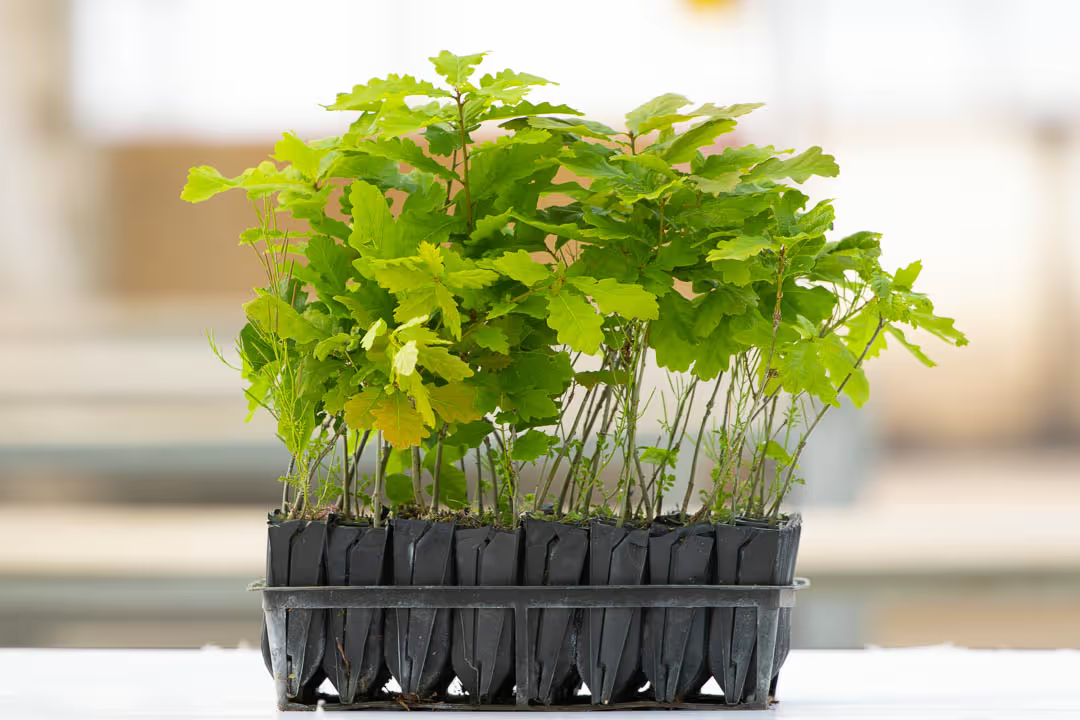
Image of cell grown oak saplings, credit: Alba Trees
Image:  cell grown oak saplings.  Credit: Alba Trees

Alba trees is the UK’s largest cell grown nursery producing 30 million trees per year across three sites in the beautiful East Lothian countryside. As an industry leader they recognise the importance of cultivating the next generation of foresters to ensure our forests and woodlands are cared for in the future and ultimately safeguarding our planet against climate change.

With the future of forestry being at the heart of Alba’s priorities they have chosen to sponsor the Early Years Award – one of 11 competitions – at the Scotland’s Finest Woods Awards 2024.

Sowing new foresters with strong roots

Margaret Allan is the Sales Manager at Alba Trees and understands first-hand the importance of instilling a passion for forestry in young people as early as possible in order to cultivate the next generation of foresters for the industry.

She stated: “We are delighted to deepen our involvement with the Scotland’s Finest Woods Awards, specifically the Early Years Award.

“It is vital that as an industry we educate young people about what we do, but also create some enthusiasm within them to work in the woodland or forestry environment when they grow up – this will make the sector stronger and also help the environment 

“Good woodland and forest management helps reduce the carbon impact on the planet as well as contributing to a vibrant sector – and it all starts with saplings in the ground, or on two little legs at their own nursery.”

Entry to Scotland’s Finest Woods Award open now for all

Last year’s winner of the Early Years Award was Bushcraft Bairns at Comrie Croft, Perthshire, who created a Forest School setting that nurtures connection with nature through play.

The criteria for entries means there is an opportunity for all – the award can be for practical or desk projects involving forestry, woodlands or trees. 

This could include a programme of learning in a woodland or forest environment or in a forest industry setting, a classroom-based study of woods and forests or the forest industry, or practical tree planting or woodland improvement projects in school grounds or in the local community.

The entry can also be for an ongoing forestry or tree related project, or one that is already completed. This year, Scottish Forestry – Outdoor Woodland Learning Scotland has created some case studies which may help to inspire you in your own entry. You can download them here.

Jean Nairn, Executive Director of Scotland’s Finest Woods, said: “Alba Trees have supported the Awards programme for many years and we are delighted to have them on board as a full sponsor this year.  They do a tremendous amount of work to make sure the stock of saplings available to foresters is healthy and strong. It also shows the importance of linking the young people with the forestry sector – promoting a career for the foresters of the future.”

Discover more

To find out more about Alba Trees go to www.albatrees.co.uk

There are 11 competitions at this year’s Scotland’s Finest Woods Awards covering Quality Timber, Farm Woodland, New Native Woodland, Community Woodland and Schools and Early Years, as well as a Climate Change Champion.

For full details, criteria and entry forms see: www.sfwa.co.uk Note – deadline is March 31.

For more information and all media inquiries please contact Nick Drainey at media@sfwa.co.uk or 07711441707

Jean Nairn has been appointed Executive Director of Scotland’s Finest Woods, responsible for running Scotland’s ‘Tree Oscars’.

Person standing in woodland
Jean Nairn, Executive Director, Scotland’s Finest Woods

Having spent more than 20 years working in and around the sector, Jean is well qualified to take on the prestigious annual Scotland’s Finest Woods Awards, celebrating all aspects of woodland and forest management, from forestry to farming, community to schools.

Jean said: “We are promoting the work carried out by forestry and farming sectors including the additional Climate Change Champion award which demonstrates best practice and innovation within the sector as well as schools and communities.” She added: “The awards are a fantastic demonstration of the diversity of people we see across the forest and woodland management sector. It is great to see how things are always moving forward with young and old being represented, something I want to continue and build on.

“Climate change is affecting every part of society and we want to promote the fantastic work being done across Scotland’s wonderful forests and woodlands to mitigate, adapt and educate the impact of a warming planet.”

With roots in the heart of ‘Big Tree Country’, Jean entered the forest industry in Scotland after graduating from Bangor University with a degree in Agroforestry. After working with Confor and Scottish Woodlands among others she has trained as a Forest Therapy Guide, certified by the Association of Nature and Forest Therapy. 

She believes it is important to recognise the forests, woodlands and managers who create the landscape, managed to industry standards, which also manifest in wellbeing benefits which can be gained by people being among the trees.

Jean added: “If we have great woodlands to enjoy, we feel better because being around trees has the ability to calm and restore us. After all, as human beings we have lived in the woods for most of our lives.

“Managing these trees through multi-purpose forestry is important and vital work in terms of having a thriving industry at the same time as feeling good and saving the planet. That is why I am thrilled and excited to take on this new role.”

Jean replaces Angela Douglas whose eight years in the role have seen the awards grow from strength to strength. Guy Watt, Chair, on behalf of the Trustees said “we would like to thank Angela for her sterling efforts during her term. We are delighted to welcome Jean who will carry on helping the awards to celebrate and recognise some of the great work being carried out across Scotland.”

For more information and interview requests please contact Nick Drainey on 07711 441707 or nicholasdrainey@gmail.com

The attached picture is of Jean Nairn, please credit SFW

Note to editors

Scotland’s Finest Woods is a charity which relies on the generosity of its partners and supporters to provide the resources needed to stage Scotland’s premier woodland awards programme.

Scotland’s Finest Woods’ key delivery partners in 2022 are:

●       BSW Timber Ltd

●       CarbonStore

●       Crown Estate Scotland

●       EGGER

●       Forestry and Land Scotland

●       Holmen Iggesund

●       James Jones & Sons Ltd

●       Outdoor & Woodland Learning Scotland

●       SAC Consulting

●       Scottish Forestry

●       Scottish Woodlands Ltd

●       Tilhill

●       Woodland Trust Scotland

Support for the awards programme in 2022 was also provided by:

●       Alba Trees

●       Caledonia Play 

●       Community Woodlands Association

●       Confor

●       Green Action Trust

●       Institute of Chartered Foresters

●       Royal Scottish Forestry Society